

 HomeHemlock Pete's HistoryBusiness PhilosophyCustomer CommentsAmazing Lady PaddlersContact Us
 CanoesWee Lassie CanoesPaddlesCustom PaddlesCurrent InventorySale ItemsOutdoor GearCustom Woodworking
 Repairs
 Paddling ArticlesWater LevelsPaddle Size GuideWhere to PaddleOther Links
Ultralight boats!
Canoe Poling
Several years ago I took a trip on the St. Johns River in Northern Maine from Baker Lake to the town of Dickey. The St. Johns is north of Moose Head Lake in the Great Northern Woods and tends to parallel the more familiar Allagash waterway. Both of them run north which is interesting.Anyway, the guy organizing the trip introduced me to poling a canoe, which is something I had never done before. Historically this was the preferred method of propulsion on the St. Johns. At the turn of the century (20th that is) logging was a major operation along the St. Johns. As there were no major roads, one of the best means of travel was by canoe. According to our guide, young men earned there keep during the summer months shuttling supplies up and down the river in a canoe. The canoe of choice in this area is a 20' model and the best way to get around in one was and still is, by using a pole.
It is amazing the control you have with one of these things. You can literally stop yourself cold in the middle of the river, move back up stream, go left, right, or just sit there and decide what you wish to do. It does take a bit of practice however. The first thing I learned was how to set the "trim" of the canoe. For our purposes we wanted the bow to be down. This would force the canoe to pivot on the front end allowing the stern to swing easily. Next, balance. I learned very quickly how to spread my feet apart and wedge them against what ever was available to stabilize my position. It worked well for me to have one foot ahead of the other. The shin on my front leg would be pressed against the thwart while the rear foot set in the chine on the opposite side of the canoe. It was not necessary to switch sides. I could maneuver the canoe in any direction from whatever side I happened to be on. I did switch my position occasionally simply for variety.
The actual poling strokes are quick simple. For forward/reverse motion you just set it on the bottom, make sure you have solid contact and then push off, walking your hands up or down the pole as needed. At the end of the action you would toss the pole forward, letting it slide through your hands, catching it at the last minute and repeating the process. "Snubbing", is when you stop or slow your forward progress in the current. To do this you jam the pole into the river bottom and push off up stream. Easier said than done with a loaded canoe in a stiff current. I learned very quickly to use a series of small snubs vs. one big one when I got lifted from the canoe on my first try. In deeper water, you can paddle with the pole. Think about it. The bite (purchase) of a paddle is governed by the surface area of the blade. The average blade (7 x 18) would have 125 sq. in. Take 8' of pole at 1.5" wide and you have 140sq. in. of surface area in the water. That's a lot of bite. The speed of the current and your predicament will dictate how quickly you need to react. Our guide never looked like he was working very hard and always managed to travel faster than I. I on the other hand did much splashing, generally was quite sweaty, and exhausted at the end of the day.

Have a question? I'm happy to answer it - just email me at hpcanoes@gmail.com

hpcanoes@gmail.com
603.667.5112

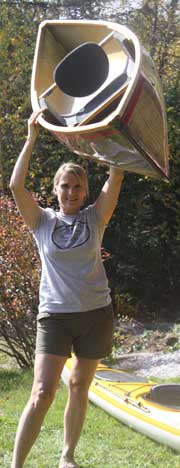
We specialize in ultralight solutions and offer expertise in canoes and Wee Lassie boats, as well as all the related equipment. Our favorites are Wenonah canoes and Wee Lassie boats. Although we will work with any material we like to get folks set up with lightweight canoes so you can dedicate your time to the joy of being out on the lakes and rivers instead of struggling to move your boat between car and water.
Scott Edwards, "Hemlock Pete" himself, offers you decades of paddling expertise. He is friendly, down-to-earth, and provides superior customer service. You won't find a better, or more pleasant, deal elsewhere.